About Mazu
A woman from a fishing island, who became a light that never went out.
The hundred poems in Tide Oracle come from a temple that has stood for more than four hundred years. This is the story of that temple, and of the woman it was built for.
From a woman to a goddess
Around 960 CE, on Meizhou Island off the coast of Fujian, a girl was born.
They called her Lin Moniang — Silent Girl — because, the story goes, she did not cry once in her first month. She grew up reading the sea the way other people read a face: she knew what the weather would do, she knew the tides, and it was said she could reach a shipwreck in her sleep and bring the lost boats home. She is said to have ascended on the Double Ninth Festival in 987 CE, twenty-seven or twenty-eight years old, and never married.
The honest historical record is much thinner than that. What scholars can establish is that written accounts of her, and temples in her name, only start appearing along the Fujian coast roughly two centuries after she is said to have died. Before that she may have been a locally respected shamaness, or a fisherman’s daughter who really did pull people out of the water. The line between legend and history is genuinely blurred here, and we would rather tell you that than hand you a myth with no seams in it.
What is not in doubt is what grew from it. More than 1,500 temples across 26 countries are dedicated to her today, and in 2009 UNESCO inscribed Mazu belief and customs on its list of Intangible Cultural Heritage. A story about one woman on one small island became a living faith carried across an ocean.
From local cult to Empress of Heaven
The state did not recognise her all at once. Between the Southern Song and the Qing, one court after another raised her rank — each promotion prompted less by doctrine than by another reported rescue at sea. You can read the list as an official record of a folk belief slowly becoming a national one.
Lady of Numinous Grace
The first formal recognition of her divinity by the court — and only at the rank of "Lady".
Princess of Numinous Grace
Raised from Lady to Princess, a step closer to the imperial house.
Princess of Heaven, Protector of the Nation
Under Mongol rule she is called "Princess of Heaven" for the first time.
Princess of Heaven, Protector of the Nation and Shelter of the People
Around the era of Zheng He’s treasure voyages the titles grow long and grand — a direct reflection of how much long-distance sea trade depended on her.
Tianhou, Empress of Heaven
Formally raised to "Empress", the rank of an emperor’s consort. This is the title she is still best known by.
Not Poseidon
If you know Greek mythology, Mazu gets compared to Poseidon — and the comparison falls apart almost immediately, because their temperaments are opposites. Poseidon is moody and punitive; cross him and the sea rises against you. In a thousand years of Mazu stories there is essentially no version where she harms anyone. Everything she does points one direction: getting people back out of the water.
For a goddess worshipped continuously for over a millennium to have no myth of vengeance at all — only rescue — says something quite precise about what people actually needed from the sea, and what they were willing to build a religion around.
Where your sign comes from
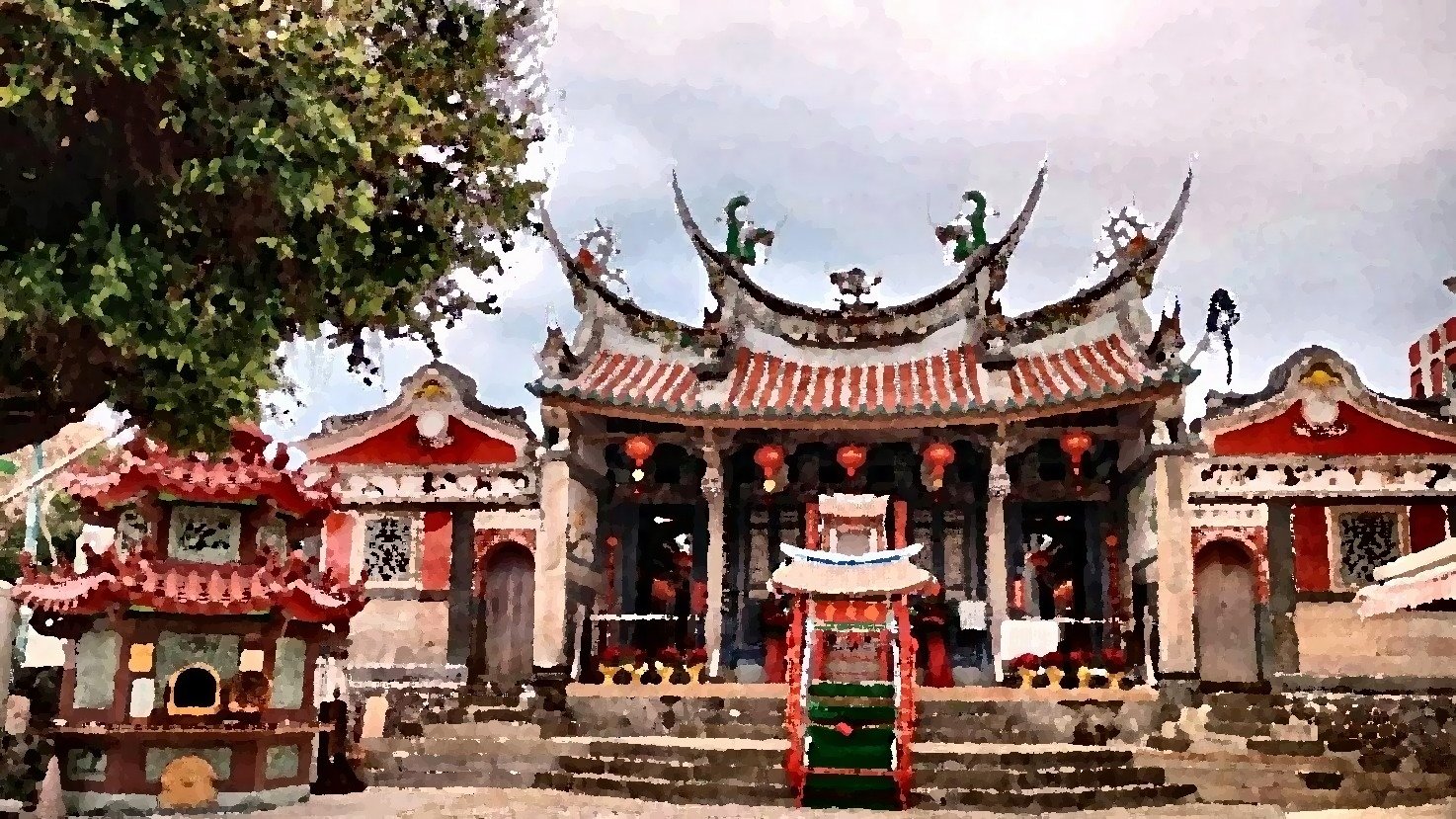
Tide Oracle’s hundred signs are not written by us. They are the poems actually used at Penghu Tianhou Temple.
The temple’s founding date is genuinely disputed. Some accounts place it in the early Ming, in the fifteenth century; others give 1593 or 1604, built by migrants from Fujian. Whichever is right, it is generally accepted as the oldest surviving Mazu temple in Taiwan, in continuous use for more than four hundred years. Magong, the city it stands in, was once called Makung — after the temple itself.
Inside there is a Mazu figure carved from a single block of wood, weighing 150 kilograms and more than 700 years old — older than any of the buildings around it. The Dutch occupied the islands in 1622 and were driven out in 1624; the temple was repaired afterwards. What you see today comes largely from a 1922 restoration led by craftsmen from Tangshan, Guangzhou and Chaozhou, and the Chaozhou-style woodcarving inside is what they left behind.
We keep all one hundred poems in their original form — not prettified, not simplified — because they are real. For centuries, real people stood in this temple with real questions and drew these exact texts.
Departure — Leaving the shore, people need more than a heading. They need to feel steady.
Storm — Mazu’s stories keep asking one question: when nothing is certain, how does a person hold themselves together?
Return — Drawing a sign is not an escape from your life. It is carrying one sentence back into it.
She keeps reminding us that gentleness can be its own kind of strength.
People have placed in her every hope they had for protection and safe passage.
What she carries is generation after generation’s longing for peace.
That care has walked beside a great many people, down a great many long roads.
Carry this history back to your reading
Most of what is told about Mazu’s life comes from legend and folk record; the firm historical evidence is limited, and scholars disagree. The same is true of the temple’s founding year, where several dates coexist. The dates, titles and figures on this page follow the sources below — if you find something that needs correcting, please tell us.
Sources: Mazu — Wikipedia, Penghu Tianhou Temple — Wikipedia, Taiwan Religious Culture Map — MOI, UNESCO Intangible Cultural Heritage, 〈東方海神的故事:中國神話媽祖〉— 國立海洋科技博物館電子專刊.